Borrowed Grief
How some of us pick up other people's pain... And why giving it back is harder than it sounds.
4/8/20268 min read
The diagnosis that wasn't mine
I remember the exact moment I heard about my aunt's glioblastoma diagnosis. I was told that my aunt was sick, but I had no idea what the sickness was. Later I caught my mother crying, and learned what it actually meant. Glioblastoma is one of the most aggressive cancers known. The five-year survival rate (an indicator of how successful treatment tends to be) sits at around three to five percent. It was a shattering piece of news for the whole family.
I was not in the room when my aunt received the diagnosis. But my connection to her was strong enough that among several other thoughts, my brain did the worst thing it could do to me at that point.
It ran a simulation.
Not of her experience, exactly. Of mine. A quiet, uninvited rehearsal: “what if that were me?” “What if I was the one sitting in that office, being handed that particular piece of news in that particular way?” It lasted only a few seconds. But it was vivid enough to leave a mark. A low hum of dread that had no real claim on me, because the diagnosis wasn't mine. I had borrowed it. And I didn't know how to give it back.
I have since learned that this is not unusual. It is not weakness, and it is not catastrophising. It is what happens when a brain wired for empathy encounters someone else's worst moment. It borrows the experience; briefly, involuntarily, convincingly. And some of us are considerably better at borrowing than we are at returning.
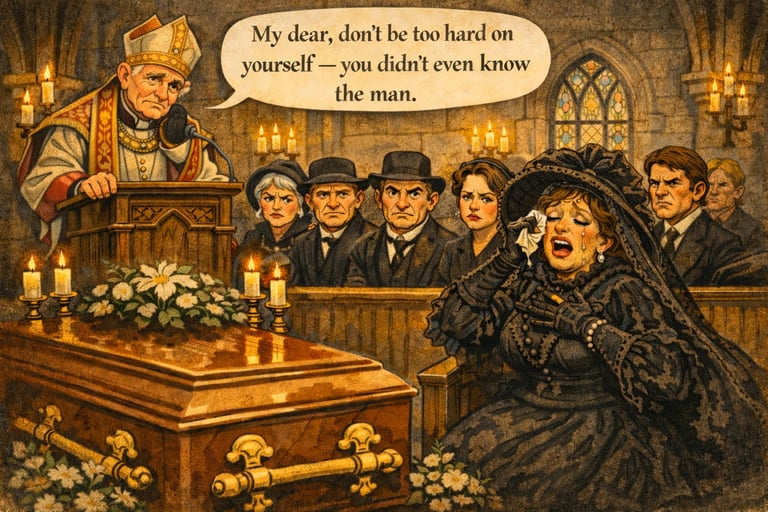
I call this Borrowed Grief.
What Borrowed Grief actually is
Before we go further, a quick clarification: this is not simply about feeling sad when bad things happen to other people. That is ordinary human empathy, and it is both healthy and appropriate.
Borrowed Grief is something more specific. It is what happens when high-empathy people don't just feel for someone; they briefly become them, cognitively. You don't observe someone else's bad news from a distance. You run it through your own nervous system. You sit in their chair, in their circumstances, with their diagnosis or their loss or their fear, and for a moment, it feels indistinguishable from your own.
Years ago, while doing EMDR therapy, I learned something that was both scientifically interesting and, in the right light, quite funny. EMDR stands for Eye Movement Desensitisation and Reprocessing, a therapy used to treat PTSD and trauma-related conditions. You listen to bilateral tapping sounds (the taps on each ear are deliberately out of sync, which engages and partially distracts the brain) while re-imagining a traumatic situation in progressively different ways, gradually becoming desensitised to it. If you were once frightened by someone jumping out of the woods, you reimagine Big Bird or a Teletubby jumping out of the woods instead. This slightly absurd reframing actually works. It alters and lightens the emotional weight attached to the memory.
During this process I learned something that has stayed with me ever since: the brain sometimes cannot distinguish between what is real and what is vividly imagined. This is why, in extreme cases, people can come to believe their own fabrications with complete sincerity. It is also why this mechanism matters so much for Borrowed Grief.
When you read something online and run the simulation — what if this were me — your nervous system responds as though the question has a real answer. It doesn't know you're just reading. The same thing happens in our lives constantly; you encounter a story, you imagine your way into it, and now it sits with you for a while.
Psychologists call the underlying mechanism perspective-taking; the ability to mentally simulate another person's experience. It is, in most circumstances, a remarkable thing to be able to do. It makes you a better friend, a more perceptive colleague, a more considered human being. It is also, under the wrong conditions, absolutely exhausting.
Because here is the thing about borrowing someone else's reality: your nervous system does not always get the memo that it isn't yours.
Why some of us can't give it back
Most people borrow and return without noticing. The news story lands, produces a brief flicker of something, and then the brain moves on. The borrowed grief is quietly handed back, filed under “sad, but not mine”, and life continues.
For others, and if you are reading this, you may recognise yourself here, the return process is considerably less smooth.
The more vividly you can imagine something, the harder it is to un-imagine it. And for high-empathy people, the simulation doesn't stay at a comfortable distance. It arrives with detail. With sensory weight. With the specific, horrible plausibility of this could happen. And once a thought is that vivid, your anxiety (ever helpful, always watching) flags it as something worth monitoring.
If you have read my piece on the Nose Notice Threshold®, you will know what happens next. The threshold drops. The borrowed grief stops feeling like a visitor and starts feeling like a resident. And the longer it stays, the more convincing it becomes that it was yours all along.
The digital volume knob
This is where the internet comes in. Not as the cause of Borrowed Grief, that mechanism is as old as human empathy, but as something far more insidious: a volume knob turned permanently to eleven, with no off switch in sight.
Before the age of constant connectivity, the opportunities to borrow someone else's grief were naturally limited. You heard bad news from people you knew, in doses your nervous system could reasonably process, with gaps in between for the borrowed weight to lift.
Now, there are no gaps. Your phone serves up a continuous, algorithmically optimised feed of other people's worst moments (diagnoses, disasters, losses, fears) each one a new borrowing opportunity before you have finished returning the last. You are never not being handed something to carry. And for a high-empathy brain, each one arrives with full simulation capability intact.
This is not doom-scrolling in the ordinary sense. You are not passively absorbing bad news. You are actively, involuntarily, running thousands of small simulations — what if that were me — and accumulating a grief that belongs to no one and everyone, and is therefore somehow harder to put down than if it were simply your own.
Just the other day I came across a post on Instagram. An Indian family; a happy husband and wife, three beautiful children. The caption below read: "They thought they were flying to a new life, but little did they know it was their last flight." The father had been offered a job in the UK. They were full of hope, perhaps imagining British citizenship, a changed future, a different family tree. And in that atmosphere of pure optimism, their plane crashed hours later. None of them survived.
That is not a story you simply shrug off and scroll past. Especially not if you have a family and were once an immigrant yourself. The simulation runs before you can stop it. “This could be us”. “This still could be us”. “What about the next time we fly to Thailand? Who knows”. And the next time you are sitting on a plane with your family, the memory will surface again, unbidden. Tap you on the shoulder. Hey. Remember me?
How to return it
This is the part nobody talks about. Not because it is complicated, but because it requires something that runs counter to every instinct a high-empathy person has deliberately putting borrowed things back.
The first step is reducing the borrowing opportunities in the first place. Accounts that traffic in stories like "She ignored the warning signs and now she is fighting for her life" are not sharing this content because it is useful to you. They are sharing it because it gets clicks; either from people whose anxiety compels them to read it, or from people who feel a quiet relief that it is not them (there is actually a German word for this: Schadenfreude, though this version is a gentler, more defensive cousin of it). Either way, the content is optimised for engagement, not for your nervous system. If an account consistently hands you things you cannot return, you are allowed to stop following it. This is not avoidance. It is triage.
The second step is trusting the mathematics. A stranger receives a devastating diagnosis somewhere in the world, and an algorithm decides you should know about it. You do not know this person. The probability of a similar catastrophe happening to you before you read the article and after you read the article is identical. Nothing has changed except that your brain is now running a simulation it was not running five minutes ago. Flying remains the safest form of long-distance travel, considerably safer than the drive to the airport actually. Most cancers are now highly treatable when caught early. The story felt relevant to you because your brain made it feel relevant. The mathematics did not change.
The third step is changing your inner language; and this one sounds almost insultingly simple, but it works, because it interrupts the simulation at the exact point it gains momentum. Instead of “what if it were me”, try “thank goodness it was not me”. You can dress it up however suits you. “Thank goodness I am in good health, and this is unlikely”. Or, if you need something with a bit more levity: “Praise the baby Jesus, not today”. Whatever creates a small distance between the thought and you is enough. You can acknowledge the sadness; “this is a terrible thing, and I feel for this family” without installing it as your own. They are one of eight billion people on this planet. You read their story. That does not make their loss yours to carry.
The fourth, and perhaps most personal, is some form of wider perspective — a sense that there is an order to things beyond what any individual news feed can capture. This does not require religious belief, though for many people a strong faith provides exactly this kind of buffer. The research broadly supports the idea that people with a coherent belief system, whether religious, philosophical, or otherwise, tend to be more resilient in the face of distressing information. The mechanism is less important than the outcome: a framework that allows the brain to file difficult news somewhere other than urgent personal threat. What that framework looks like is yours to decide. I have found mine in spirituality and reading a lot about the research helped me a lot. More on this in another post.
The borrowed grief was never yours to keep. The vivid simulation, the lingering dread, the tap on the shoulder at 30,000 feet — these are the price of a brain that can imagine its way into other lives. That capacity is not a flaw. Most of the time, it makes you better at being human.
It just occasionally needs reminding that other people's stories, however real they feel, belong to other people.
You are allowed to give them back.
Image credits: Header image generated with ChatGPT (DALL·E), April 2026. "I can't carry it for you, but I can carry you" GIF from The Lord of the Rings: The Return of the King (2003) — © New Line Cinema / Warner Bros., used for commentary and humour under fair use. Pennywise GIF from IT (2017) — © Warner Bros., used for commentary and humour under fair use.

Remember me?
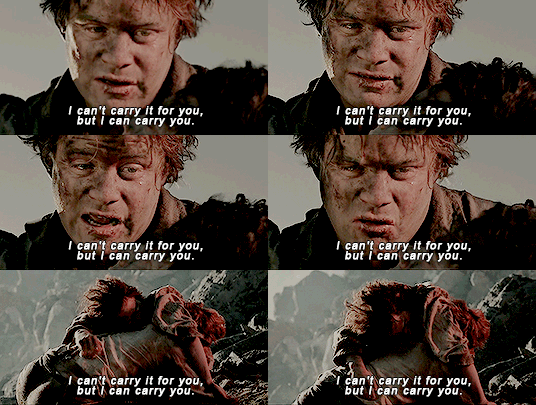
No you don't have to Sam! The ring was his burden.
Stay
Join the MyWeirdSymptoms community to stay in touch!
Subscribe to My newsletter
© 2025-2026. All rights reserved.
Disclaimer
The content on My Weird Symptoms is for informational and entertainment purposes only. Nothing on this site is intended to be, or should be taken as, medical advice, diagnosis, or treatment. All opinions expressed here are the author's own and are based on personal experiences, research, and humour — not professional medical training.
Always seek the guidance of a qualified healthcare professional with any questions you may have regarding your health or a medical condition. Never disregard professional medical advice or delay seeking it because of something you've read here. If you think you may be experiencing a medical emergency, call your doctor or emergency services immediately.
Copyright & Fair Use
My Weird Symptoms occasionally uses images, graphics, or short clips from third-party media (such as TV shows, movies, and books) for purposes of commentary, criticism, humour, education, or parody. These materials remain the property of their respective copyright holders. We make no claim of ownership and do not intend to infringe on any copyrights.
Such use is intended to fall under fair use (17 U.S.C. § 107) as commentary, criticism, or parody. We use only small portions necessary to illustrate our commentary and always provide proper attribution where possible. If you are a copyright holder and believe any content should be removed, please contact us, and we will address it promptly.
Accuracy & Liability
While we strive for accuracy, information on this site may become outdated or contain errors. We make no guarantees about the completeness, reliability, or accuracy of information presented. Any action you take based on information from this site is strictly at your own risk.