Eardrum trembling every time I moved my eyes
I noticed it before it was formally documented - How a foam earplug accidentally revealed something your brain is doing to your ears right now.
3/19/20268 min read


After health anxiety took hold of my sleep, I became what I can only describe as a cat sleeper. You know how a peacefully napping cat can go from zero to sprinting in a single heartbeat the moment it hears a sound — before it has even processed what the sound was? That was me. Every creak, every car, every nothing in particular.
If you have read my piece on the Nose Notice Threshold®, you will know that anxiety doesn't just make you worry — it physically lowers the threshold at which your brain flags things as threatening. Your nervous system becomes a hair trigger, permanently set to respond first and ask questions later. Sleep, for a system running at that sensitivity, starts to feel less like rest and more like a hostage situation.
How hearing actually works (bear with me)
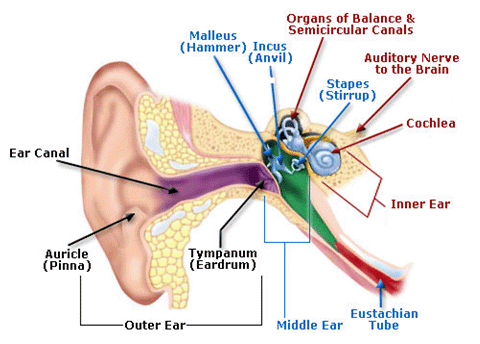
Before we go further, a quick detour into anatomy — because what comes next will make a lot more sense if you have the picture in your head.
Sound is just air moving in waves. When those waves reach your ear, they hit a thin membrane stretched across the end of your ear canal: the eardrum. The eardrum vibrates in response — trembling at the same frequency as the incoming sound. So far, so intuitive.
Behind the eardrum sits the middle ear, which contains three of the smallest bones in the human body. They are called the malleus, incus, and stapes — though hammer, anvil and stirrup is the more satisfying translation. These three bones are connected in a chain, and when the eardrum trembles, it moves the hammer, which moves the anvil, which moves the stirrup, which taps against a membrane leading into the inner ear. From there, the signal becomes electrical, travels up the auditory nerve, and your brain decides what you heard.
The whole chain is extraordinarily sensitive. The eardrum can respond to displacements smaller than the diameter of a hydrogen atom. Which is all to say: it does not take much to set it moving.
Keep that in mind.
Earplug comes into play
In an attempt to block out external stimuli while sleeping, I started using earplugs. If you have never used foam earplugs, here is how they work: you roll the foam into a narrow cone, insert it into your ear canal, and the foam slowly expands back to its original shape, sealing the canal. For side sleepers, your pillow pushes the plug deeper, which pushes harder against your eardrum. Cozy.
But while earplugs reduce external noise, they also open the doors to a brand-new realm: internal bodily sounds. Some of it is what you might loosely call tinnitus — though tinnitus itself comes in more flavours than just ringing, which I will get into in a separate post. There are also stranger sounds that seem to come from the ear canal itself: a kind of uuaauuuuaaa oscillation, like two voices alternating between high and low with no apparent rhythm or trigger, that is hard to describe and harder to explain away. (potentially a phenomenon called Spontaneous otoacoustic emissions (SOAEs), see what doors a lowered anxiety threshold opens!) Unsettling at first, but you learn to file them under “probably fine”.
Then one night, something else entirely showed up.
Tatatatata
A trembling sound from my left ear. Not ringing, not pulsing — a rapid, mechanical flutter. Tatatatata. It would last one or two seconds, stop, then come back every few seconds like clockwork. When I loosened the plug slightly, it got fainter. When I removed it altogether, it vanished.
This happened several nights in a row. Same ear. Same sound. Same mystery.
By the third night, the engineer in me had had enough. I cannot help it — it is how my brain is wired, and if you have read the About page you will know I am not a medical professional, just someone with a compulsion to trace effects back to causes until the thing makes sense. So I started running deliberate experiments.
I moved my eyes left, right, up, down. There it was. Tatatatata. Every single time. I moved them again. Again. Again. The flutter followed every eye movement like a shadow. Getting more intense when I change the direction of the eye movement, then slowing down a bit.
I was not even that surprised, and here is why.
The toilet flush that turned off the lights
At a rental we lived in years ago, the bathroom light would switch off every time we flushed the toilet. Every. Time.
My wife did not believe me until I demonstrated it. I still remember the puzzled look on her face. The electrician I called did not believe me until I demonstrated it to him too; and watched his smirk disappear in real time. 😊
While look quite mysterious, potentially out of a haunted mansion type horror movie, the cause turned out to be a freshwater pipe running right alongside the electrical wiring. When the cistern filled and the valve snapped shut, it sent a vibration through the pipe, which was enough to trip the nearby wiring and cut the light.
Two completely unrelated systems. One affecting the other simply because they were neighbours.
So, when I found that moving my eyes was causing a sound in my ear, I applied the same logic. I thought perhaps the muscles controlling eye movement must run close to the middle ear — the eardrum, the tiny bones. Movement in one system was creating a ripple in the other.
Plausible. Satisfying. But then things got stranger.
A fraction too early
As if that weren't mysterious enough, things started getting stranger.
I started paying closer attention to the timing. And something was off. The trembling was not happening during my eye movement. It was happening just before, a few milliseconds before my eyes actually starts moving.
If this were purely mechanical (vibration from eye muscles travelling to the eardrum) the sound should arrive with the movement, or just after it. Physics says so. But this tremble was starting earlier. A fraction of a second, but consistently, unmistakably starts earlier and continued as long as I move my eyes.
I sat with that in the dark for a long time. I had no explanation for it. And an unexplained symptom, for someone like me, is not something you can simply put down and walk away from. But I also knew exactly what would happen if I brought it to a doctor: the careful nod, the neutral expression, and behind the eyes, the gentle but firm conclusion that I was probably fine and also a bit much.
This is the curse of unusual symptoms when you are not a Hollywood celebrity with a personal physician running rare diagnostic panels on your behalf. No specialist is going to hear "my eardrum trembles when I move my eyes" and light up with recognition or call WHO committee for an emergency meeting. You are more likely to get a slightly too-long pause and a referral to sleep hygiene. So, I sat on this for years. Filed it under weird, kept it to myself.
Then an article arrived
A study had found that when humans move their eyes, the brain sends a preparatory signal to the eardrum, causing it to begin vibrating just before the eye movement happens.
The proposed reason: balance calibration. When your eyes shift, your brain briefly tells your ears to stand down — essentially dampening the incoming audio signal so that the sudden visual motion does not throw off your sense of balance. It is a coordination mechanism, running silently in the background every time your gaze moves.
This is happening to you right now, as you read this. Your eardrums are trembling every time your eyes jump between words. You just cannot hear it. Those who read my NNT blog post would understand.
Most people cannot hear it at all, as the tremble is faint, and we do not possess the superpowers to hear such low noise under normal conditions.
So why could I?
My best guess: the earplug.
When a foam plug is seated in the canal, it traps a small volume of compressed air between itself and the eardrum. This likely amplifies the drum's movement, turning a microscopic vibration into something large enough to register as sound. The plug may also press the drum inward slightly, bringing it into closer contact with the small bones of the middle ear, making the trembling more mechanically audible.
As for why only my left ear: eardrums vary slightly in thickness, tension and shape between individuals and even between ears. If one drum bulges slightly more when compressed by a plug, it stands to reason that it would respond more noticeably to the brain's signal.
These are guesses. Educated ones, but guesses. The study confirmed the mechanism — it did not come with a personalised explanation for my left ear specifically.
A win for people like us
I will not pretend I was not a little proud.
Lying in the dark, rolling a foam earplug between my fingers, I had stumbled onto something that had not yet been formally documented. No lab, no funding, no ethics committee. Just a restless sleeper, an earplug, and an inconvenient engineering brain that cannot let things go unexplained.
But honestly, the pride is only half of it. The other half is something closer to relief — and I suspect some of you reading this will know exactly what I mean.
When you live with health anxiety, you develop a complicated relationship with your own observations. You notice things. You interrogate them. And then you spend an equal amount of energy second-guessing yourself, because the alternative — telling someone, going to a doctor, being looked at like you have personally wasted their afternoon — feels worse than just sitting with the mystery. You learn to quietly distrust your own findings before anyone else gets the chance to.
So, when that newspaper article confirmed that yes, the brain really does send a signal to the eardrum before eye movement, and yes, this is a real documented phenomenon. It was not just intellectually satisfying. It was a small, quiet vindication of the whole process. Of paying attention. Of refusing to dismiss something just because it sounded strange.
Our bodies are doing extraordinary things constantly, most of which go completely unnoticed. Occasionally, under the right conditions (a foam earplug, a sleepless night, a brain that will not let things go) you catch a glimpse of one of them.
Our bodies are deeply, gloriously weird. Most of it is nothing. File it under fascinating and move on.
Mass: 1. Science: 0.
Image credits: Header image generated with ChatGPT (DALL·E), March 2026. Jumpscare cat GIF via Tenor. The Conjuring scene GIF via Yarn — © Warner Bros., used for commentary and humour under fair use. Ear anatomy GIF, author unknown, sourced from OSHA (1999) — public domain, via Wikimedia Commons. Captain America meme created via Imgflip — © Marvel Studios, used for commentary and humour under fair use.



Nothing demonic, of course — but still weird


So I am not that crazy after all...


Stay
Join the MyWeirdSymptoms community to stay in touch!
Subscribe to My newsletter
© 2025-2026. All rights reserved.
Disclaimer
The content on My Weird Symptoms is for informational and entertainment purposes only. Nothing on this site is intended to be, or should be taken as, medical advice, diagnosis, or treatment. All opinions expressed here are the author's own and are based on personal experiences, research, and humour — not professional medical training.
Always seek the guidance of a qualified healthcare professional with any questions you may have regarding your health or a medical condition. Never disregard professional medical advice or delay seeking it because of something you've read here. If you think you may be experiencing a medical emergency, call your doctor or emergency services immediately.
Copyright & Fair Use
My Weird Symptoms occasionally uses images, graphics, or short clips from third-party media (such as TV shows, movies, and books) for purposes of commentary, criticism, humour, education, or parody. These materials remain the property of their respective copyright holders. We make no claim of ownership and do not intend to infringe on any copyrights.
Such use is intended to fall under fair use (17 U.S.C. § 107) as commentary, criticism, or parody. We use only small portions necessary to illustrate our commentary and always provide proper attribution where possible. If you are a copyright holder and believe any content should be removed, please contact us, and we will address it promptly.
Accuracy & Liability
While we strive for accuracy, information on this site may become outdated or contain errors. We make no guarantees about the completeness, reliability, or accuracy of information presented. Any action you take based on information from this site is strictly at your own risk.